
AOC’s “Word Salad” In Munich
Put Her Foreign Policy Skills Under a Microscope

My first question is why is she there and what is she trying to prove? My second question, Is this the best the Democrats have to offer? When a U.S. lawmaker takes the stage at the Munich Security Conference, the stakes are different. This isn't cable news or a campus speech. It's one of the world's biggest gatherings for security leaders, where every sentence gets weighed, clipped, and replayed.
In February 2026, Rep. Alexandria Ocasio-Cortez (AOC) joined panels in Munich and drew heavy attention for the way she answered high-pressure foreign policy questions. Critics quickly labeled parts of her performance "word salad," meaning a long, tangled response that sounds serious but leaves listeners unsure what was actually said.
Supporters heard a politician trying to tie global threats to working people at home. Opponents heard a speaker who couldn't land clear answers on war and peace. In that debate, a blunt line kept showing up from critics: "She is out of her league. She is out of touch with foreign Affairs." It's a charged claim, but it captures why Munich became a flashpoint.
This post looks at two lenses: what AOC seemed to be trying to argue, and why critics say it came off unclear or factually shaky.
What AOC was trying to say on the world stage in Munich
AOC's core message in Munich wasn't hard to spot. She framed foreign policy as something regular Americans feel through prices, jobs, migration, and the risk of war. In her telling, democracies weaken themselves when they preach rules but don't follow them consistently. That hypocrisy, she suggested, makes it easier for strongman politics to grow.
She also tried to connect security to economics. Competition with China, protection of intellectual property, and control of key supply chains all showed up in her remarks. So did broad themes about allies sharing burdens, and the need to prevent conflicts from igniting in places like Eastern Europe and the Indo-Pacific.
The problem is that security forums reward clean structure. They reward short answers first, then details. When a speaker leads with a long runway, listeners can lose the plot.
That dynamic matters because Munich is not a campaign stop. It's where leaders signal priorities to allies and adversaries. When that signal comes through fuzzy, people fill in the blanks with their own assumptions.
Allies and NATO: the "show up prepared" argument
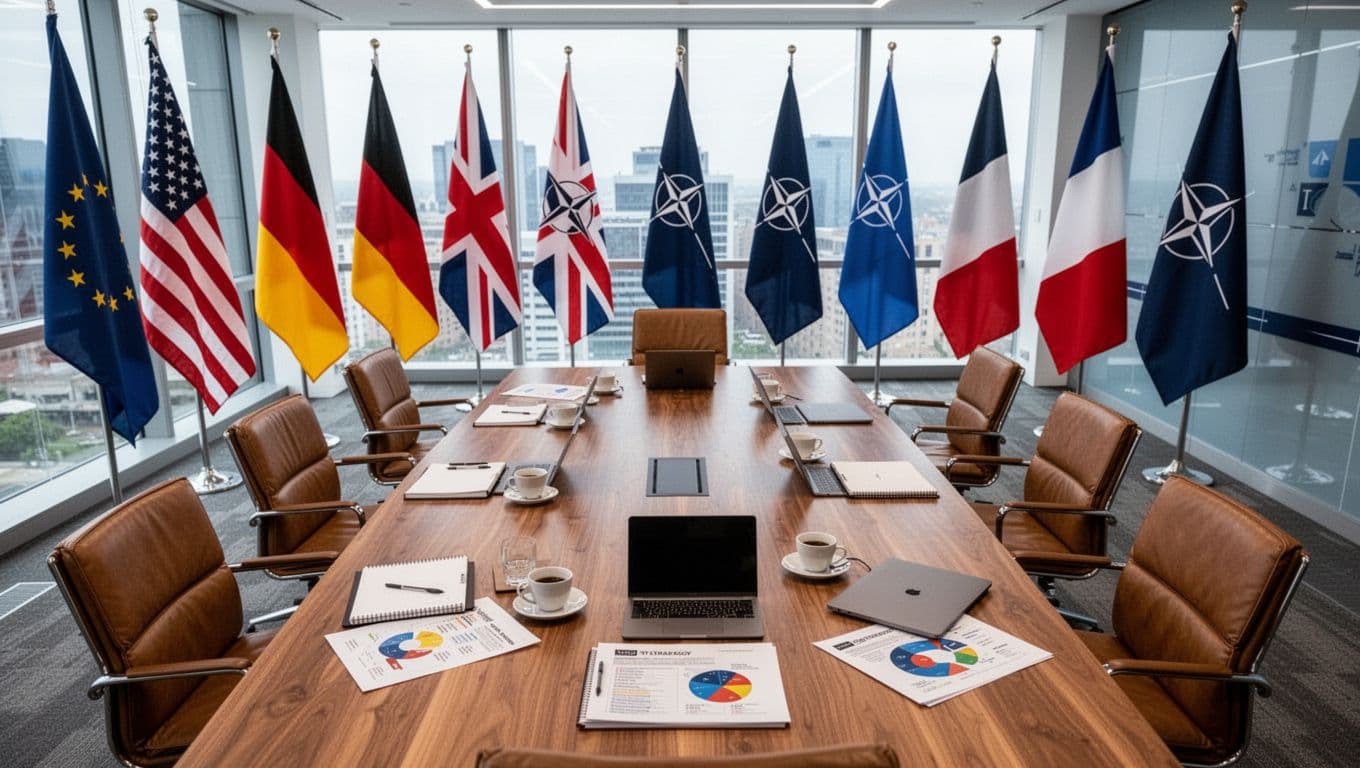 An alliance-focused meeting setting similar to what leaders discuss around NATO readiness, created with AI.
On burden-sharing, AOC leaned into a point many U.S. officials have made for years: allies should invest enough in their own defense that collective defense is credible. In plain English, a team works better when every player shows up in shape.
That idea lines up with a less-famous part of NATO's logic: countries should be able to maintain and build their own capacity before a crisis hits. NATO's mutual defense promise gets the headlines, but readiness starts earlier. If nations can't move troops, protect infrastructure, or stock basic supplies, Article 5 becomes a slogan instead of a plan.
AOC's "preparedness first" framing also fits the political mood in the United States. Many voters ask why Washington pays so much for global stability when problems at home feel urgent. Her answer, at least in spirit, was to push allies to carry more weight so the U.S. isn't always the emergency backstop.
Still, critics argued that strong themes need strong delivery. A speaker can have a fair point and still lose the room if the point arrives late, or arrives wrapped in too many side arguments. That's part of what made her Munich appearance go viral, especially in clips like AOC's "word salad" moment in Munich.
China, chips, and economic security: why tech came up
AOC also treated economic security as national security, which is now mainstream in Washington. The logic is simple: if a rival can choke off key materials or steal high-value know-how, the damage looks like a national crisis fast.
Semiconductors sit at the center of that worry. Chips power weapons systems, communications, cars, medical devices, and the entire cloud economy. That's why "chip supply chains" have become a foreign policy topic, not just a business one.
Europe shows up in this story because parts of the chip pipeline depend on specialized firms there. ASML, for example, is often cited as a critical company in advanced chip-making equipment. When U.S. leaders talk about export controls or technology safeguards, they can't do it alone. They need alignment with European partners.
In Munich, AOC's broad warning about intellectual property theft and tech competition fit the setting. It also fit a larger trend: economic tools now function like defense tools. Sanctions, export controls, and investment screening all shape the battlefield without a shot fired.
Where she ran into trouble is the same place many politicians do. Big themes can sound abstract if they aren't tied to a clear choice. What should the U.S. do tomorrow, next year, and in a crisis?
The moments critics called "word salad," and why they landed poorly
AOC didn't face only friendly prompts in Munich. She was pressed on hard questions that demand a direct posture, especially on Taiwan and military commitments. Several moments then spread online because the answers sounded long, hesitant, or loosely stitched together.
To be fair, foreign policy questions often don't have neat answers. Leaders also avoid boxing themselves in. Yet audiences can still tell when a speaker is dodging versus when they're weighing tradeoffs out loud.
In Munich, critics highlighted the pauses, the winding phrasing, and the way different topics sometimes blended together. They also argued that she mixed moral judgment with policy in ways that made her sound more like a commentator than a decision-maker.
One reason the backlash hit hard is that Munich is filmed, subtitled, and instantly shareable. A small stumble becomes a headline when it feels symbolic of a bigger issue: preparation.
Coverage of the broader blowback, including the "gaffe" framing, appeared in pieces like Fox News reporting on AOC being mocked over Munich remarks. Whether a reader agrees with that tone or not, it reflects how the story was sold to many Americans.
At global security forums, clarity isn't a style choice. It's the job. When answers get muddy, opponents define them for you.
When a Taiwan question needs a clear yes or no, voters notice
 The Taiwan Strait is often discussed in terms of deterrence and risk, created with AI.
Taiwan is one of those topics where ambiguity is both policy and problem. The U.S. has long tried to deter aggression while avoiding a formal promise that could force a war. Still, when a speaker is asked point-blank about committing U.S. troops, audiences expect a crisp answer, even if it's carefully worded.
Reports from the event said AOC paused for nearly 20 seconds before responding, then emphasized the goal of avoiding a clash with China. On one level, that's a normal goal. Every responsible leader wants to avoid war.
However, the question wasn't "Do you want peace?" It was closer to "What would you do if deterrence fails?" When a speaker replies with process language, diplomacy, research, positioning, critics hear a non-answer.
That's why the "word salad" label stuck. A long response can sound like fog when the audience wants a compass bearing. The moment also fed a familiar political attack: that she speaks in values but struggles with execution.
How small factual slips become big headlines
The second problem wasn't tone, it was basics. Critics seized on alleged factual errors and awkward references, then used them to argue she wasn't prepared for a world stage.
One example that circulated involved geography. Commentators said she referenced Venezuela as being below the equator while making a point about the limits of U.S. power. The punchline wrote itself for social media: Venezuela sits north of the equator. A single map check could have prevented days of mockery.
Another criticism centered on historical and cultural references. In a separate moment reported in media coverage, she mocked a comment about the roots of U.S. cowboy culture and Spain. That's tricky terrain because the history is layered. Spanish and Mexican vaquero traditions shaped what Americans later called "cowboy" culture, alongside the labor of Black Americans and others. When a speaker laughs at a simplified claim, then answers with another simplified claim, the audience hears heat, not light.
She also faced backlash for language about Israel and Gaza while in Germany, as well as for framing global politics through class struggle. Religious and political critics portrayed that framing as ideological. Supporters countered that human rights language should apply everywhere. Either way, the communication lesson is the same: sweeping moral claims draw maximum scrutiny when the setting is symbolic.
On the internet, a small slip rarely stays small. Clips travel faster than corrections. Once a "pattern" narrative forms, every new stumble gets filed under the same label.
Why this matters for 2028, and for Democrats trying to look serious on foreign policy
Munich didn't just create a weekend of headlines. It offered a preview of how a politician gets tested when the questions shift from domestic priorities to command-level risk.
If AOC runs for higher office, her opponents won't debate her best speech. They'll replay the messiest 12 seconds. That's true for any candidate in 2028, but it's sharper for leaders best known for domestic messaging.
This is also bigger than one lawmaker. Democrats have internal disagreements on foreign policy language, especially on Israel and Gaza, how to talk about Ukraine, and how hard to go at China without sliding into prejudice. In that environment, even friendly audiences want one thing first: clarity.
That's why the line from critics, "She is out of her league. She is out of touch with foreign Affairs.", became a ready-made caption. It may be unfair as a total judgment, but it's effective politics. It tells voters, "Don't trust her with hard power."
Related coverage of the "not great" framing, including remarks from commentators across the spectrum.
Sound bites shape trust, even when policy goals are popular
AOC's "working people" frame can land with Americans who feel squeezed. The trouble is that foreign policy audiences measure trust differently. They ask: can this person manage a crisis call at 3 a.m.?
When answers come out in a spiral, the policy can vanish inside the delivery. Think of it like a pilot announcement during turbulence. Passengers don't need a dissertation on aerodynamics. They need the simple facts first, then reassurance, then details.
A cleaner structure often looks like this:
First, answer the question in one sentence. Next, name the tradeoff. Then, give the reason. Finally, say what you'd do next.
That doesn't guarantee good policy. It does prevent opponents from writing your message for you.
A simple checklist for judging speeches without picking a team
If you're watching political clips and trying not to get pulled into tribal cheering, it helps to use a neutral filter. Here's a quick way to score any foreign policy answer.
| What to listen for | What it sounds like in plain English |
|---|---|
| Did they answer the question? | "Yes," "No," or "Here's our policy," up front |
| Are the basics right? | Correct geography, timelines, and key facts |
| Did they name the tradeoff? | "If we do X, we risk Y, but we gain Z" |
| Did they state a next step? | A concrete action, not only a hope |
The takeaway is simple: you can disagree on policy and still demand a clear, accurate explanation.
Conclusion
AOC went to Munich with real themes: allies sharing defense burdens, China and tech competition, and the pressure points around Ukraine, Iran, and wider stability. Those topics fit the room. Still, critics argue her delivery and a few headline-making slips undercut her message, especially when she faced direct questions like Taiwan.
In politics, a confusing answer doesn't just sound bad, it can read as weak leadership to voters who want steadiness. That's why this Munich "word salad" moment became a story that followed her back home. If future candidates want to look ready for the world stage, clarity might matter as much as conviction.
Stay Informed
When you subscribe to the blog, we will send you an e-mail when there are new updates on the site so you wouldn't miss them.