(VICR) Vicor Corporation
The Quiet Power Behind Loud AI Racks
 A view of a modern data center aisle where power delivery becomes a real constraint.
If you've been watching AI servers get denser and hotter, you've probably noticed the same thing I have: power is turning into a performance bottleneck.
That's where Vicor Corporation (VICR) fits. In plain English, Vicor makes high-end power conversion modules. These are the parts that take electricity from one form and "re-shape" it so advanced electronics can use it safely and efficiently.
I think of it like power plumbing. GPUs and CPUs don't just need electricity, they need the right voltage, delivered fast, with low loss and low heat.
As an investor, I treat VICR as both a business story and a stock setup, not a sure thing. Patriot Market Research rates VICR a Strong Buy, and the growth and profitability scores behind that call are hard to ignore. At the same time, it flags real risks, especially valuation and customer concentration.
What Vicor actually sells, and why its power tech matters for AI and defense
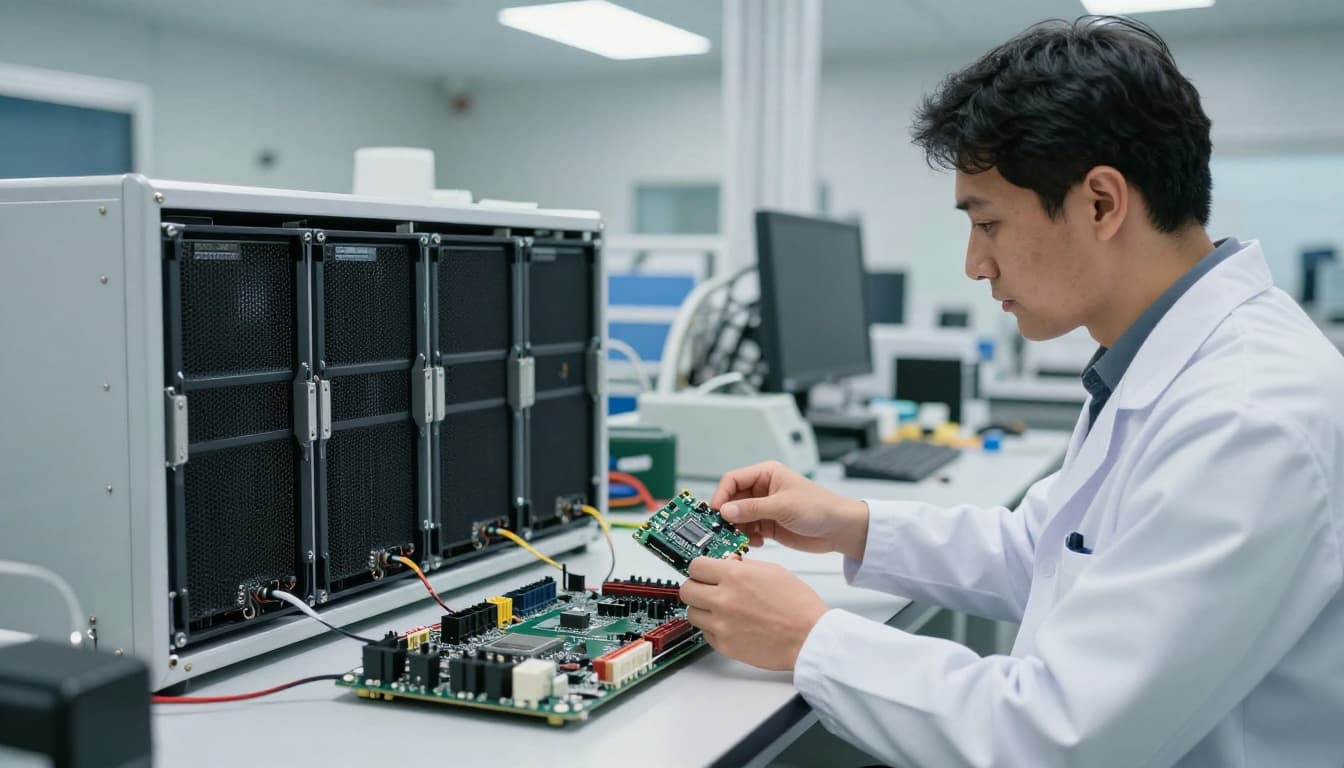 A lab scene showing the kind of compact power modules Vicor designs around.
Vicor, founded in 1981 and based in Andover, Massachusetts, designs and manufactures modular power components and full power systems. The company sells DC-DC converters, AC rectification components, and custom power solutions. It supports customers across the US, Europe, and Asia Pacific through subsidiaries and support centers.
What makes Vicor different is its reputation for high efficiency and high power density, meaning it can push a lot of power through small hardware with less waste heat. That's a big deal in AI servers where every watt lost becomes heat you must remove.
A major theme is 48V power distribution. Data centers have been moving toward higher-voltage distribution inside the rack because it can cut losses and reduce copper. Vicor also promotes its Factorized Power Architecture (FPA), which is basically a way to split up the power conversion job so power can travel efficiently, then get "finished" close to the chip that needs it.
These ideas matter outside AI too. Aerospace and defense systems care about reliability and performance under harsh conditions. Industrial and automotive designs care about space, thermal limits, and efficiency because that drives size, cost, and uptime.
When compute gets dense, power stops being "background." It becomes a front-and-center design limit.
ChiP modules and Vertical Power Delivery, the small parts doing big work
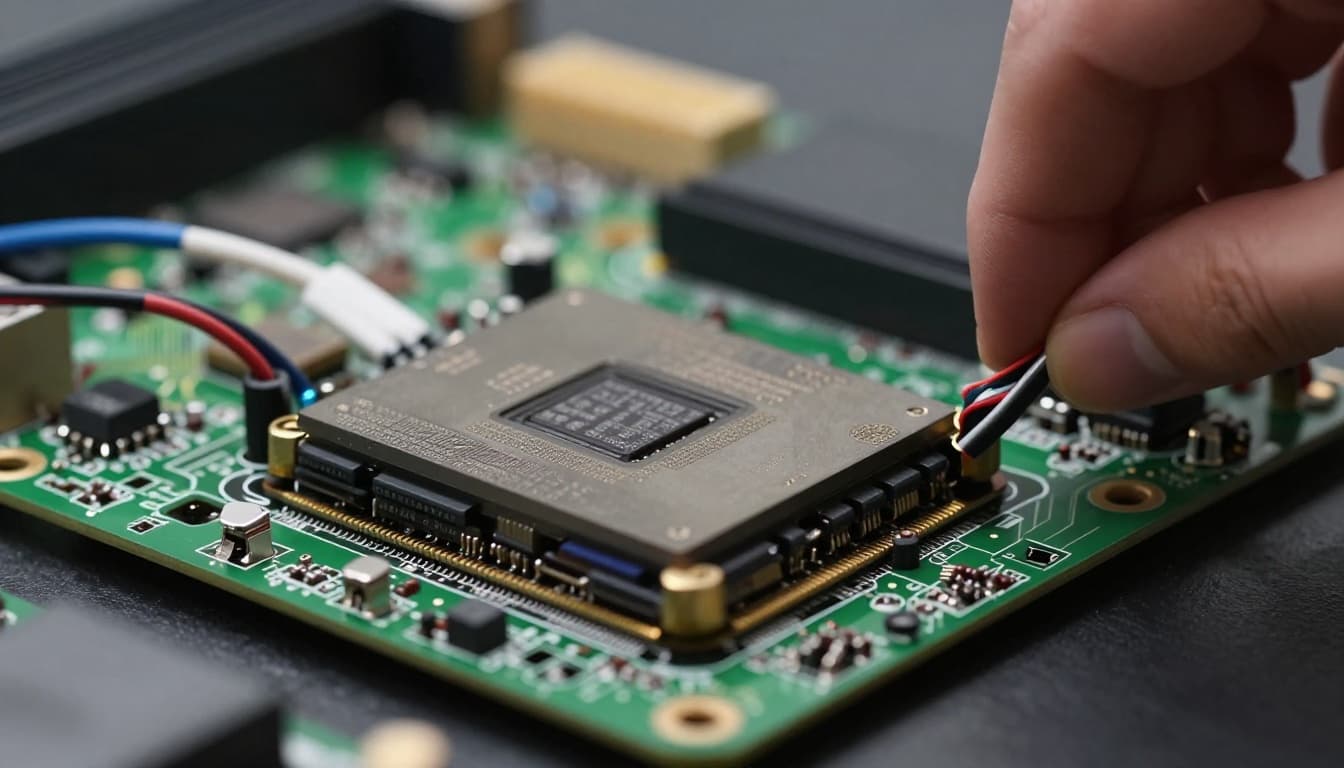 A close-up showing power conversion hardware sitting close to a processor.
Vicor's ChiP (Converter housed in Package) modules are essentially power converters in a tight package. The pitch is simple: smaller module, high efficiency, and less wasted space.
Vertical Power Delivery (VPD) is about getting power closer to the processor. Shorter paths mean less loss and better control when a GPU suddenly pulls more current. That can support higher performance without turning the board into a space heater.
I've also seen Vicor highlight newer generations of its platform, including Gen 6 sampling for denser compute needs. For me, the key is not the generation name. It's whether new modules show up as more product revenue and improving margins over time.
Where Vicor shows up, hyperscale AI, aerospace and defense, and industrial systems
 A split scene reflecting two end markets where advanced power design matters.
Vicor sells into several end markets investors tend to care about: data centers and hyperscale computing, telecommunications, aerospace and defense, automotive, and industrial equipment.
The upside of these markets is obvious. They're power-hungry and performance-driven. The downside is also obvious. Demand can be lumpy, and a few large customers can swing results more than people expect.
That concentration risk is one of the main "don't ignore this" points raised by Patriot Market Research, and I agree with it. If a hyperscaler pauses a buildout, the supplier chain feels it fast.
The VICR stock story in early 2026, strong momentum, strong margins, and a pricey valuation
 A desk scene capturing the "numbers and narrative" side of following VICR.
VICR has been moving fast. The stock closed at $187.68 on February 24, 2026, up 9.2% from the prior day, with about 533K shares traded. The beta sits around 1.90, which matches how this name behaves, it can swing hard.
Valuation is the other headline. A trailing P/E around 72 and a forward P/E in the mid-60s means the market expects strong growth and clean execution. Patriot Market Research frames it the same way: top-tier growth, profitability, momentum, and earnings revisions, but a stretched valuation score.
On results, Vicor's Q4 2025 numbers were strong:
- Q4 total revenue about $107.2M, including $92.7M product revenue and $14.5M royalty revenue.
- Q4 EPS was $1.01.
- Q4 gross margin was 55.4%.
For full-year 2025:
- Product revenue: $350.3M
- Royalty revenue: $57.4M
- Plus a $45M patent settlement, bringing total revenue to $452.7M
- Net income: $118.6M, with EPS of $2.61 (a huge jump from 2024's $0.14)
Those numbers help explain why Patriot Market Research shows an A+ growth profile and strong profitability metrics (including a net margin that has been far above typical sector levels). Still, premium pricing cuts both ways. When expectations get this high, the stock has less room for stumbles.
Key financial signals I'd track each quarter

A snapshot of what it looks like to track earnings with a highlighter and a skeptical eye.
When a stock is priced like a winner, I focus on a few signals that can't hide behind buzz:
- Revenue growth rate: I want acceleration that matches the AI power narrative.
- Gross margin trend: Vicor sits in the mid-50% range recently, so I watch for a steady climb, not one-off spikes.
- Net margin stability: Patriot Market Research cites unusually strong margins for the sector, so any fade matters.
- Advanced vs. Brick mix: In 2025, Advanced Products grew (Advanced Products revenue was $248.6M, up 26%), while Brick Products slipped ($159.1M, down 1.6%).
- Royalties and licensing: royalty revenue is real money, and licensing can add a higher-margin layer.
- Customer concentration clues: I read for hints that growth is broadening beyond a small set of buyers.
My simple rule: 48V and AI ramps should show up in product revenue, not just headlines.
Valuation reality check, when great companies can still be risky stocks

A visual of the tradeoff every VICR investor has to face.
Patriot Market Research makes the valuation point bluntly. Vicor trades at a big premium to its sector on common multiples. For example, it highlights EV/Sales around 18.8 versus a sector median near 2.1, and Price/Book around 10.8versus about 3.4.
That doesn't mean the stock must fall. It does mean the market is already paying for a lot of future wins. So if revenue growth or customer demand wobbles, the stock can react fast.
Bull case vs. bear case for Vicor, what could go right, and what could go wrong
 A "two paths" image that matches how I think about VICR as a stock.
The bull case is easy to explain. AI data centers need better power delivery, and Vicor is positioned right where the pain is. If 48V designs keep spreading and Vicor keeps winning sockets, product revenue can scale quickly. Add strong margins and royalty income, and you get operating power that looks impressive.
Patriot Market Research also points to positive estimate revisions and strong momentum. It even flags the licensing side as improving, with backlog and profitability trending up, which can support a "multiple expansion" story if results stay hot.
The bear case is more about execution and market structure. Patriot Market Research warns that commercial execution has been uneven, and that a lot of upside may already be priced in. In addition, competitors like Monolithic Power Systems, Texas Instruments, and Analog Devices can offer cheaper, more scalable options. That can limit how much share Vicor captures, even if its tech is excellent.
What could drive the next leg higher, factory scale, new modules, and royalty leverage
 A cleanroom scene that fits the idea of scaling manufacturing and process control.
If I'm bullish, I'm watching for proof that Vicor can scale supply as demand rises. Patriot Market Research mentions a new US-based ChipFab and points to capacity expansion plans, including talk of a second fab. I don't treat factory plans as revenue. Still, better capacity can reduce lead times and support bigger design wins.
I also like the idea of royalties and licensing as an extra lever. Royalties can smooth cycles when product orders fluctuate. Bulls sometimes talk about Vicor reaching a much larger revenue run rate over time (even a $1 billion run rate ambition shows up in commentary), but I keep it in the "possible" bucket until quarterly numbers confirm it.
The biggest risks I see, customer concentration, competition, and insider selling headlines
 A moment that captures how headline risk feels when a stock is extended.
My top risk remains customer concentration. When a few hyperscalers and chipmakers drive demand, any pause can hit growth. Patriot Market Research calls this out as a core vulnerability.
Competition is the next risk. Larger rivals can undercut pricing, bundle solutions, and out-scale production. Even if Vicor's modules perform better, purchasing teams don't always pay extra unless the payoff is clear.
Finally, insider selling can add pressure when valuation is already rich. In February 2026, a Vicor VP sold shares around the mid-$170s, and the CEO sold shares in December 2025. Insider sales aren't always bearish, people diversify and plan sales, but they can cool sentiment when the stock has run this far.
Conclusion
 A calm desk setup that matches a slower, rules-based way to follow a volatile stock.
Vicor sells the "power plumbing" that helps AI servers, defense systems, and industrial hardware run faster and cooler. The recent financial rebound is real, with strong 2025 results, solid Q4 EPS, and margins that many hardware companies would envy. At the same time, Patriot Market Research likes the growth and profitability picture while still warning about valuation and execution risk.
My next steps stay simple: I read the latest earnings release, I track margins and revenue mix, and I look for signs that demand is broadening beyond a few customers. Then I compare the current valuation to realistic growth, and I set clear rules for position size and downside. If the power bottleneck story keeps turning into revenue, VICR can justify its premium, but I don't give it a free pass.
When you subscribe to the blog, we will send you an e-mail when there are new updates on the site so you wouldn't miss them.