(ZM) Zoom Communications
Profit, Growth, and the Next Catalyst
Remote teams using a familiar video-call setup.
Zoom is no longer "just meetings." Today, Zoom Communications, Inc. (ZM) sells a wider work platform that covers meetings, phone, chat, docs, and even contact center tools. It also leans hard into AI features that promise to save time. The company officially shifted its name in November 2024, moving away from the "Video" label and into a broader identity.
Here's the quick snapshot that shapes my view: Zoom looks very profitable, and it has used buybacks to help lift per-share results. At the same time, revenue growth looks slower than many software peers, and a choppy job market can still drag on seats, renewals, and upgrades.
This post uses a Patriot Roundtable Analysis framework, meaning I'm balancing product reality with the numbers that investors actually trade.
What Zoom actually sells now, and why it is more than video calls
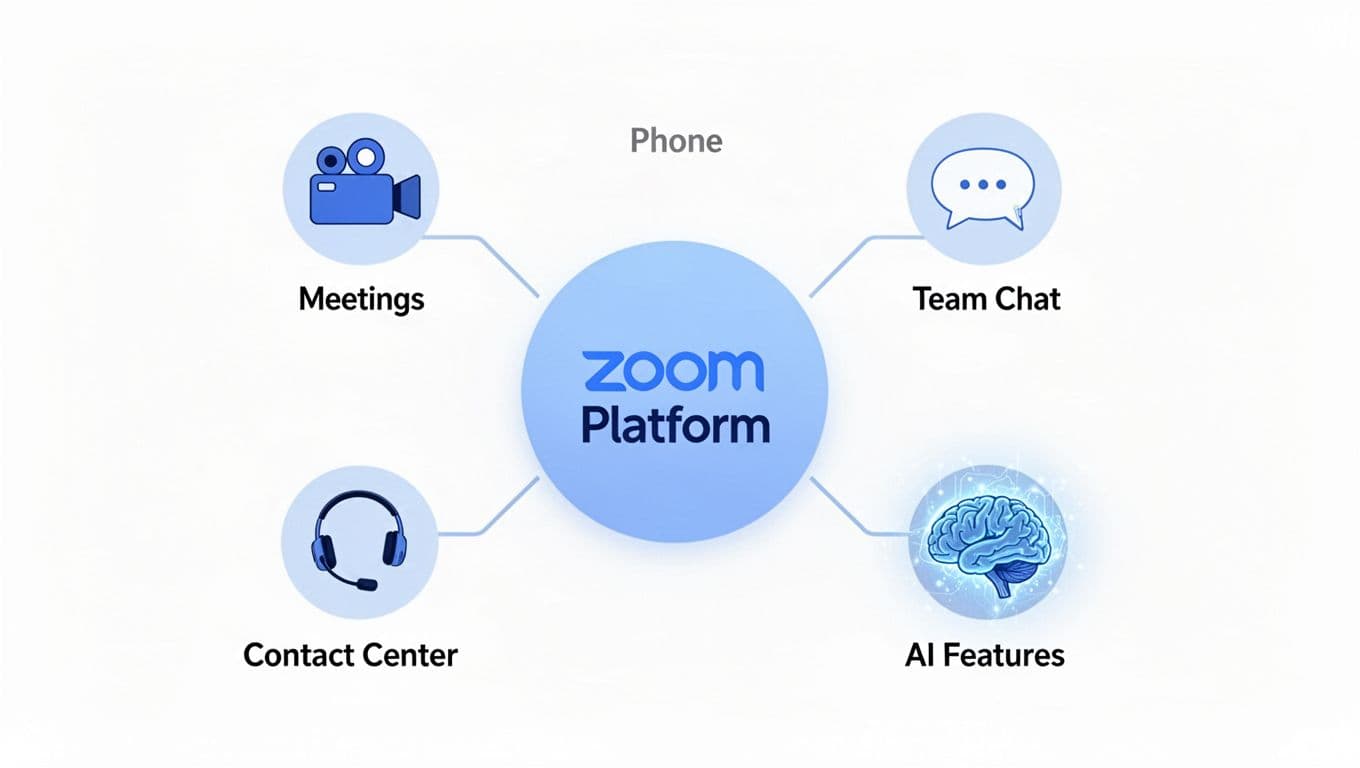
One platform view of Zoom's main product lines.
When I explain Zoom to friends, I use a simple picture: it's a "work conversations" company. Meetings brought people in, but the money gets steadier when customers also pay for phone, chat, and support tools.
Zoom mainly makes money through subscriptions. Individuals and small teams pay monthly, but enterprises tend to sign bigger contracts and expand over time. That expansion is the heart of the story, because a single product is easy to cancel, while a stack of tools is harder to unwind.
The product mix matters because each layer can increase revenue per customer:
- Meetings and Chat keep daily usage high.
- Phone replaces legacy phone systems with a cloud plan.
- Contact center tools move Zoom closer to customer support budgets, not just IT.
- AI features can justify upgrades if they save real time.
If Zoom succeeds, it becomes less like a single app and more like a "default workspace" for calls, messages, and customer conversations.
The core apps that keep customers inside the Zoom platform
 Zoom's core set goes well beyond Meetings. In plain terms, it's trying to bundle the workday so customers don't bounce between five vendors.
Here's what I watch in that bundle:
Zoom Meetings still anchors the brand. It's the front door. Zoom Team Chat keeps people in Zoom between calls. Zoom Phone adds a recurring seat-based fee and can replace desk phones. Then there are the productivity add-ons, like Mail and Calendar, Docs, Whiteboard, Clips, and workflow automation tools.
The business logic is simple. If a company only uses Meetings, it's shopping a commodity. If it uses Meetings, Phone, Chat, and Whiteboard, it's paying for a system.
A practical example: picture a 600-person company with a hybrid workforce. They run weekly all-hands on Meetings, use Team Chat for day-to-day updates, and roll out Zoom Phone to stop paying for old PBX hardware. Support teams then pilot Zoom Contact Center for inbound requests. That's four products, four budget lines, and a lot of day-to-day dependence. At that point, switching stops being a weekend project.
This is why Zoom keeps widening the suite. It's less about novelty, and more about reducing churn by becoming "sticky."
Where the AI-first push can matter most
 Zoom calls itself an AI-first work platform, and I think the best AI features are the boring ones. The ones that quietly give time back.
In real workflows, AI helps when it does things people hate doing, like:
- Creating meeting summaries and action items
- Capturing tasks without manual note-taking
- Pulling highlights from a long call recording
- Improving customer support routing and agent assist in a contact center
That last one is important. AI inside a contact center can be tied to business outcomes, like faster resolution and better customer satisfaction. Those are easier to justify in a budget review than "nice-to-have" meeting features.
Still, traction doesn't guarantee fast adoption. If budgets stay tight, teams delay upgrades. If small businesses churn more in a weak economy, new AI tools don't fix that overnight. I treat AI as a real product path, but not a magic wand.
My biggest AI test is simple: does it drive paid upgrades, or does it just sound good in a demo?
My Patriot Roundtable Analysis: the numbers that shape my ZM view

A simple "report card" view of Zoom's factor grades.
Zoom is one of those stocks where the story sounds mixed, and the grades look mixed too. In my notes, it earns top marks for profitability, strong marks for momentum and revisions, and weak marks for growth.
The headline profitability metric that jumps out is a net income margin around 33%, far above a sector median that's closer to mid-single digits in many screens. That tells me Zoom can run efficiently, even with slower growth.
Momentum has been solid in the same dataset, with a six-month performance around 24%, well ahead of a flat sector median in that snapshot. That kind of move usually signals that expectations were too negative, then reset.
Earnings revisions have also looked supportive, with 27 upward EPS revisions and 1 downward over a recent three-month window in the dataset I'm using. I don't treat analyst revisions as gospel, but I respect direction, because it can shape sentiment.
Quick scorecard table (grades) plus the few metrics I care about most
First, here's the grade view I'm using in this Patriot Roundtable Analysis.
| Factor | Grade | What it tells me |
|---|---|---|
| Valuation | C | Not cheap on every metric, even if some ratios look reasonable |
| Growth | F | Forward growth looks slow versus many software peers |
| Profitability | A+ | Strong margins suggest tight cost control and pricing power |
| Momentum | B | Recent price action has improved sentiment |
| Revisions | B+ | More upward EPS changes than downward recently |
Next, I keep a short list of "headline metrics" to avoid getting lost in noise. Some figures differ by source (especially P/E), so I note ranges and context.
| Metric | Value (Feb 2026 context) | Why I care |
|---|---|---|
| Stock price | ~$90.96 | Sets expectations for risk and upside near-term |
| Market cap | ~$26.9B to ~$27.3B | Tells me it's a large-cap software name, not a small story stock |
| Forward P/E (one dataset) | ~15.26 | A forward-looking valuation lens tied to estimates |
| P/E (another real-time quote) | ~17.70 | Quote providers may use different earnings bases, I sanity-check both |
| Forward EPS growth | ~5.19% | Slow growth can still work if buybacks and margins stay strong |
| Forward revenue growth | ~4% | This is the core "why it's a Hold" number for me |
| Net income margin | ~33% | Shows the business throws off real profit |
| 6-month performance | ~24% | Helps me gauge momentum and crowd psychology |
| EPS revisions (3 months) | 27 up, 1 down | Signals estimate direction, not certainty |
| Debt/equity | ~0.01x | Low financial risk from leverage in my notes |
| Current ratio | ~4.36x | Suggests strong liquidity in the same snapshot |
| TTM revenue | ~$4.81B | A quick size and stability check |
| EBITDA | ~$1.3B | Another window into operating cash generation |
| Last reported EPS (quarter) | $1.52 vs $1.21 est. | A meaningful beat can reset sentiment fast |
The takeaway: Zoom looks like a mature, profitable software company with improving sentiment, but not the kind of grower that gets forgiven for missteps.
How share buybacks and strong cash flow can boost EPS even when growth is slow

One Zoom point that's easy to miss is the buyback effect. When a company retires shares, EPS can rise even if total profit grows slowly. That can also make valuation multiples look better over time.
In my notes, Zoom's repurchase pace gets called "aggressive," backed by a strong cash position. If management keeps buying stock, long-term holders can benefit from a shrinking share count. It's like owning a slightly bigger slice of the same pizza each quarter.
However, I don't confuse buybacks with growth. If demand softens, buybacks can't force customers to renew. They can support EPS, but they can't fully offset a weak top line forever.
So I treat buybacks as a positive "support beam," not the whole house.
The bull case and the bear case for ZM going into the next earnings
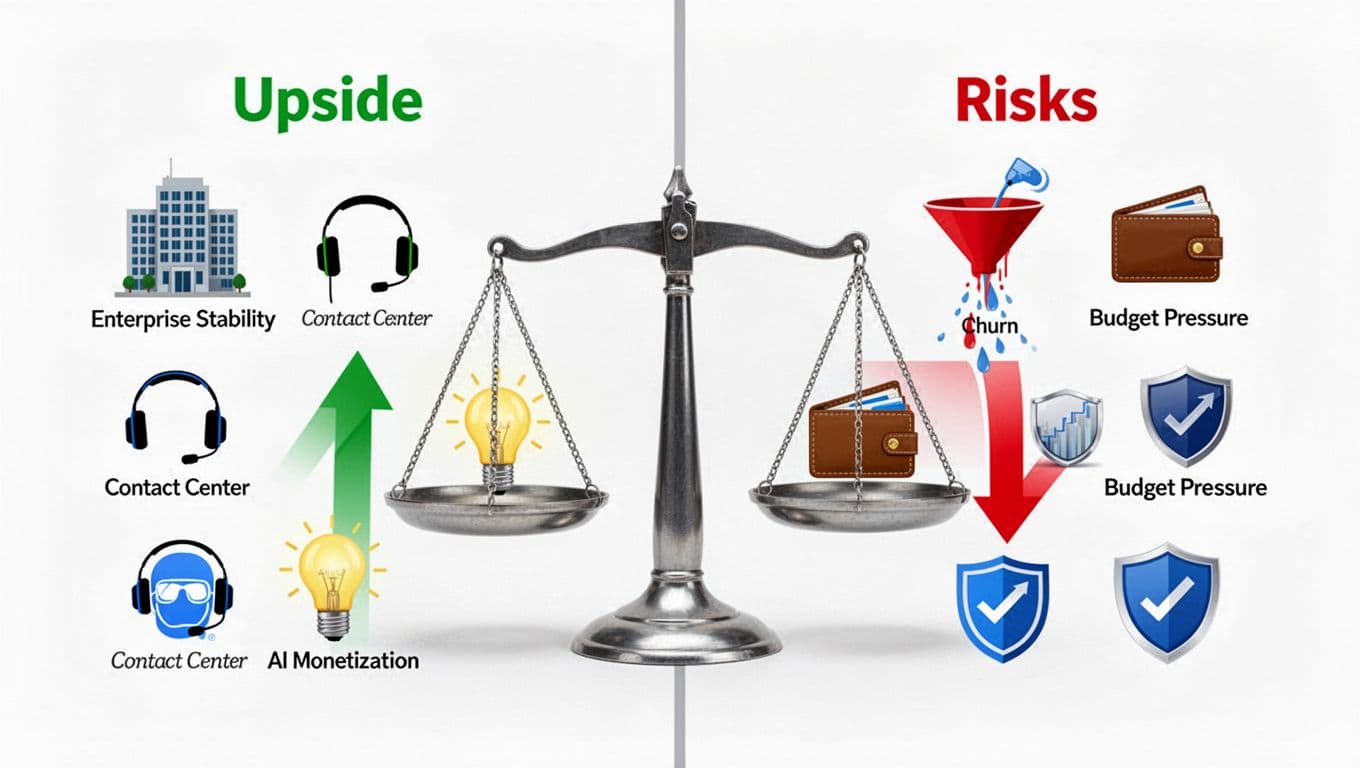
A balanced view of potential upside and risks.
When I map Zoom's setup, I don't start with a heroic story. I start with what needs to be true for the stock to work from here.
On the upside side, enterprise can stabilize results and Zoom can monetize customer experience products. On the risk side, macro pressure can keep churn elevated and slow upgrades.
What could go right: enterprise stability, contact center wins, and better monetization

The encouraging thread in my notes is enterprise stabilization. Large customers tend to move slowly, but once they standardize, they can expand seats and add products. That "land and expand" math matters more than a flashy new feature.
Zoom also has real shots on goal outside meetings. Products like Zoom Contact Center, Zoom Revenue Accelerator, and events tools give it more ways to grow wallet share. Contact center is especially interesting because it points at support budgets, and it can connect to measurable KPIs.
AI-led customer experience features also create a clearer path to monetization. If AI helps agents handle more chats per hour, it's easier to sell. That's different from AI that just writes a nicer summary.
I also pay attention to sentiment. In the commentary I track, Zoom often lands in "Hold" territory, not hated but not adored either. If execution improves, that kind of lukewarm mood can flip, because expectations start low.
What could go wrong: churn, budget pressure, and a tough path back to double-digit SaaS growth

The bear case is straightforward: slow growth stays slow.
Some analysts worry Zoom's long-term upside stays muted if it can't return to faster SaaS growth or earn a new valuation story. If revenue keeps crawling around low single digits, investors may keep treating it as a cash cow, not a compounder.
Macro is part of it. A backdrop with layoffs and higher jobless claims can hit new seat adds, especially in smaller online cohorts. In that environment, churn can rise and upgrades get delayed.
Competition is also real. Microsoft bundles collaboration into broader suites, Cisco Webex keeps a strong footprint in many enterprises, and RingCentral competes hard in cloud phone. For smaller customers, switching costs aren't always high. If a team only uses meetings, moving can be annoying but not impossible.
Zoom can be "good" and still not be "fast." That gap is what creates most of the stock debate.
How I would approach ZM as an investor (without overcomplicating it)

I keep my Zoom plan simple because the stock can tempt people into headline trading. If the company is profitable and buying back shares, I don't need it to become a rocket ship. I just need it to execute steadily and avoid demand shocks.
Also, I separate what I can measure from what I can't. I can measure revenue growth, margins, and share count. I can't measure hype.
My simple checklist for the next quarter

I use a short checklist so I don't overreact to one press release. This isn't financial advice, just how I keep myself disciplined.
- Revenue growth direction: Is it still around the low single digits, or does it start to improve?
- Enterprise customer trends: Do large customers expand, or do they pause?
- Churn signals: Do they call out pressure in online cohorts or small business demand?
- Attach rates: Are Phone and Contact Center expanding per customer?
- AI that drives upgrades: Do AI features lead to paid tiers, not just usage?
- Operating margin discipline: Do they protect profitability while investing?
- Share count trend: Do buybacks keep shrinking the pie slices outstanding?
When those items line up, I get more confident. When several move the wrong way at once, I step back
Price levels and expectations I set so I do not panic trade

As of February 2026, ZM trades around $90. I don't treat that number as "cheap" or "expensive" by itself. Instead, I anchor it to expectations.
Because Zoom has improved momentum in some datasets, I assume the next earnings reaction can be sharp. That cuts both ways. So I plan ranges.
On my chart, I usually mark a "floor zone" in the high $80s and a "ceiling zone" in the mid-$90s, then I update those levels as price action changes. I'm not trying to predict the next tick. I'm trying to avoid buying in the middle of emotional noise.
I also write down the catalyst date I'm trading around. Earnings calendars shift, so I confirm the exact report date before I act. Then I decide in advance what would change my mind, like a revenue re-acceleration sign or a clear attach-rate jump in Phone or Contact Center.
Conclusion: A profitable Hold setup, with one key thing to watch

My Patriot Roundtable Analysis view on Zoom is close to a Hold: profitability is excellent, momentum has improved, and revisions have looked supportive. Still, slower growth and macro risk can cap upside if customers stay cautious.
Going into the next earnings, I'm watching three things: revenue growth direction, attach rates for Phone and Contact Center, and whether AI features create paid upgrades. If those improve together, the story gets simpler. If they don't, Zoom can stay a strong business that trades sideways.
If you follow ZM, build a watchlist and track those three metrics next quarter. The stock doesn't need a miracle, it needs steady proof.
When you subscribe to the blog, we will send you an e-mail when there are new updates on the site so you wouldn't miss them.